Workshop update
Thank you to everyone who submitted. We received close to 90 abstracts, spanning 15 countries and 42 institutions. All submitted abstracts have been accepted. Acceptance notifications have now been sent to the submitting authors. The preliminary programme is now available and shows whether each contribution is scheduled as an oral presentation or a poster. Registration is now open (see Registration below). If you have any questions, please contact us by email.
About the workshop
The workshop brings together researchers, instrument developers, data-product teams, validation and in situ measurement specialists, and users working across the microwave radiometry spectrum.
Its purpose is to strengthen interaction between the L-band and higher-frequency radiometry communities, promote the combined use of observations at different frequencies, and support discussion across missions, agencies, institutes, and application areas.
Active development of L-band algorithms, new multi-frequency observing capabilities, and emerging mission concepts create significant opportunities to improve the retrieval and interpretation of land-surface variables. At the same time, stronger connections are needed between communities working at different frequencies, and between algorithm development, calibration and validation, instrumentation, and applications.
Topics
We welcome abstracts addressing microwave radiometry of land surfaces, including but not limited to:
- Soil moisture, vegetation and vegetation optical depth, freeze/thaw state, snow, land-surface temperature, drought indices, surface water, carbon cycle, and inundation
- Retrieval algorithms and forward modelling
- Calibration and validation methods
- Validation sites, field campaigns, and instrumentation
- Multi-frequency retrievals and applications
- Simulation, laboratory, and in situ measurements of the electromagnetic properties of natural media
- Future technologies and new instruments; radio frequency interference (RFI) detection and filtering
- Synergies with complementary observations, including GNSS reflectometry and synthetic aperture radar
- Operational applications, user requirements, and emerging societal needs
- Land, ocean, and cryosphere synergies
Contributions that connect traditionally separate frequency ranges, observing systems, disciplines, or application communities are especially encouraged.
Keynote speakers
We are pleased to confirm the following keynote speakers:
- Christian Mätzler (University of Bern, Switzerland)
- Dara Entekhabi (Massachusetts Institute of Technology, USA)
- Craig Donlon (European Space Agency (ESA) – ESTEC, Netherlands)
- Gabriëlle De Lannoy (KU Leuven, Belgium)
Special sessions
Future L-band and multi-frequency radiometry concepts
Future satellite and airborne radiometry concepts, including high-resolution L-band approaches, wideband and multi-frequency systems, and upcoming or proposed missions.
Freeze/thaw algorithms and applications
Continuing discussions from the 2024 Freeze/Thaw Workshop in Guelph, Canada: algorithm development, intercomparison, validation, product consistency, applications, and opportunities for coordinated community activities.
Abstract submission
Abstract submission closed on 7 October 2026. For questions, please contact us by email. We aim to send notifications of acceptance by 30 October 2026.
The scientific programme will be built from the submitted abstracts, and may include oral presentations, posters, panel discussions, and focused working sessions.
Important dates
| Abstract submission opens | 1 Sep 2026 |
| Abstract submission deadline | 7 Oct 2026 |
| Acceptance notifications | Sent |
| Registration deadline | 30 Nov 2026 |
| Workshop | 26–28 Jan 2027 |
Programme
The workshop begins on the morning of Tuesday 26 January 2027 and concludes by 16:00 on Thursday 28 January. The schedule leaves ample room for discussion, networking, and the development of community recommendations and collaborative activities.
The preliminary programme is now available, covering three days of sessions, keynotes, and posters.
View the preliminary programme →You can also download the printable PDF.
Venue and practical information
Finnish Meteorological Institute — Dynamicum
Erik Palménin aukio 1, 00560 Helsinki, Finland
Dynamicum is located near the Kumpula Campus of the University of Helsinki, a short bus or tram ride from the Helsinki city centre.
Accommodation
There are many hotels in Helsinki city centre and nearby, with easy access to the venue by public transport. A few good options:
- Scandic Hakaniemi
- Scandic Grand Central
- Original Sokos Hotel Vaakuna
- Original Sokos Hotel Tripla
- Hilton Helsinki Strand
- Hotel Arthur
- Noli Sörnäinen
Public transport
Helsinki has a good public transport network. Journey planning and ticket information can be found on the HSL website; we recommend the HSL app, which makes it easy to buy tickets and plan journeys. The journey planner also indicates which zones you need a ticket for. In general, travelling from Helsinki-Vantaa Airport to the city centre or the venue requires an ABC ticket, while an AB ticket is sufficient between the city centre and the venue.
Directions to the venue
The venue is at Erik Palménin aukio 1, near the Kumpula Campus of the University of Helsinki. It can be reached from the city centre in approximately 20–30 minutes by bus or tram. The nearest stop when coming from the city centre is Kumpulan kampus; from the bus and tram stops, walk up the hill towards the university campus area.
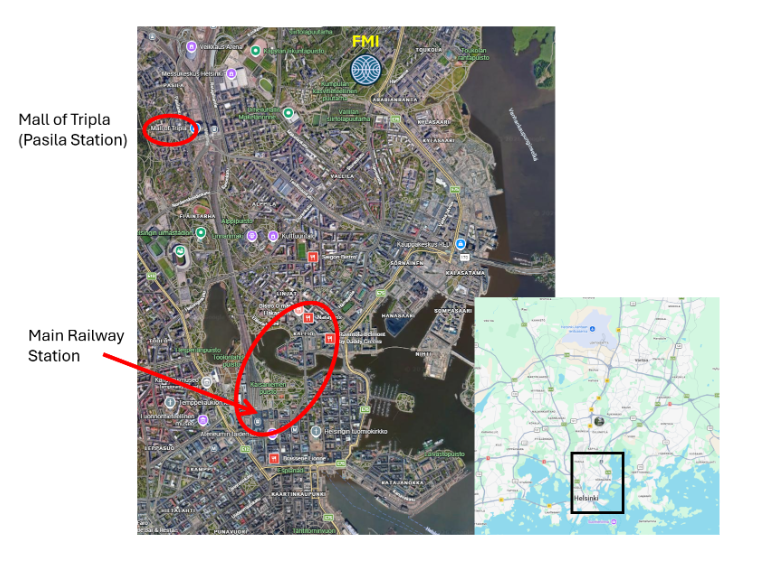
More detailed directions, including how to get from the airport to the city or the venue, are available on the FMI directions page.
Weather and clothing
Expect typical January weather: temperatures around −10 °C, snow, and roughly six hours of daylight. We recommend warm winter clothing (a warm jacket, a hat, mittens, and a scarf) and warm winter boots with good grip, as paths may be snowy or icy.
Registration
Register for the workshop →Committees
Scientific steering committee
- Simone Bircher — MeteoSwiss, Switzerland
- Ardeshir Ebtehaj — University of Minnesota, USA
- Iris de Gélis — Estellus-MW, Observatoire de Paris, France
- Hyunglok Kim — GIST, South Korea
- John Kimball — University of Montana, USA
- Yann Kerr — CESBIO, France
- Giovanni Macelloni — IFAC, Italy
- Sidharth Misra — JPL, USA
- Colleen Mortimer — Environment and Climate Change Canada, Canada
- Ghislain Picard — University of Grenoble, France
- María Piles — University of Valencia, Spain
- Alexandre Roy — Université du Québec à Trois-Rivières, Canada
- Mike Schwank — WSL / Gamma, Switzerland
- Jeff Walker — Monash University, Australia
- Pierre Zeiger — University of Grenoble, France
FMI organising committee
- Andreas Colliander
- Manu Holmberg
- Anna Kontu
- Juha Lemmetyinen
- Juliette Ortet
- Kimmo Rautiainen
- Lina Zschenderlein
- Patrik Ahola
- Kerttu Kouki
Contact
Questions about abstracts, the programme, or practical arrangements — contact us by email.